Two Decades Later: Revisiting the 2006 FA Cup Final That Still Stings
Supporting West Ham has a way of teaching you to find beauty in disappointment. The bittersweet moments stick with you longer than the straightforward ones—they're the memories that genuinely matter, the ones your brain refuses to let go of.
It's a club that forces you to appreciate both the clouds and their silver linings. The inaugural season I properly recall was that grim campaign when 42 points wasn't enough to keep the Irons up—the year half of England's finest got relegated alongside them. And the club anthem? "I'm Forever Blowing Bubbles" carries a melancholy that feels entirely fitting for a side forever teetering on the knife's edge.
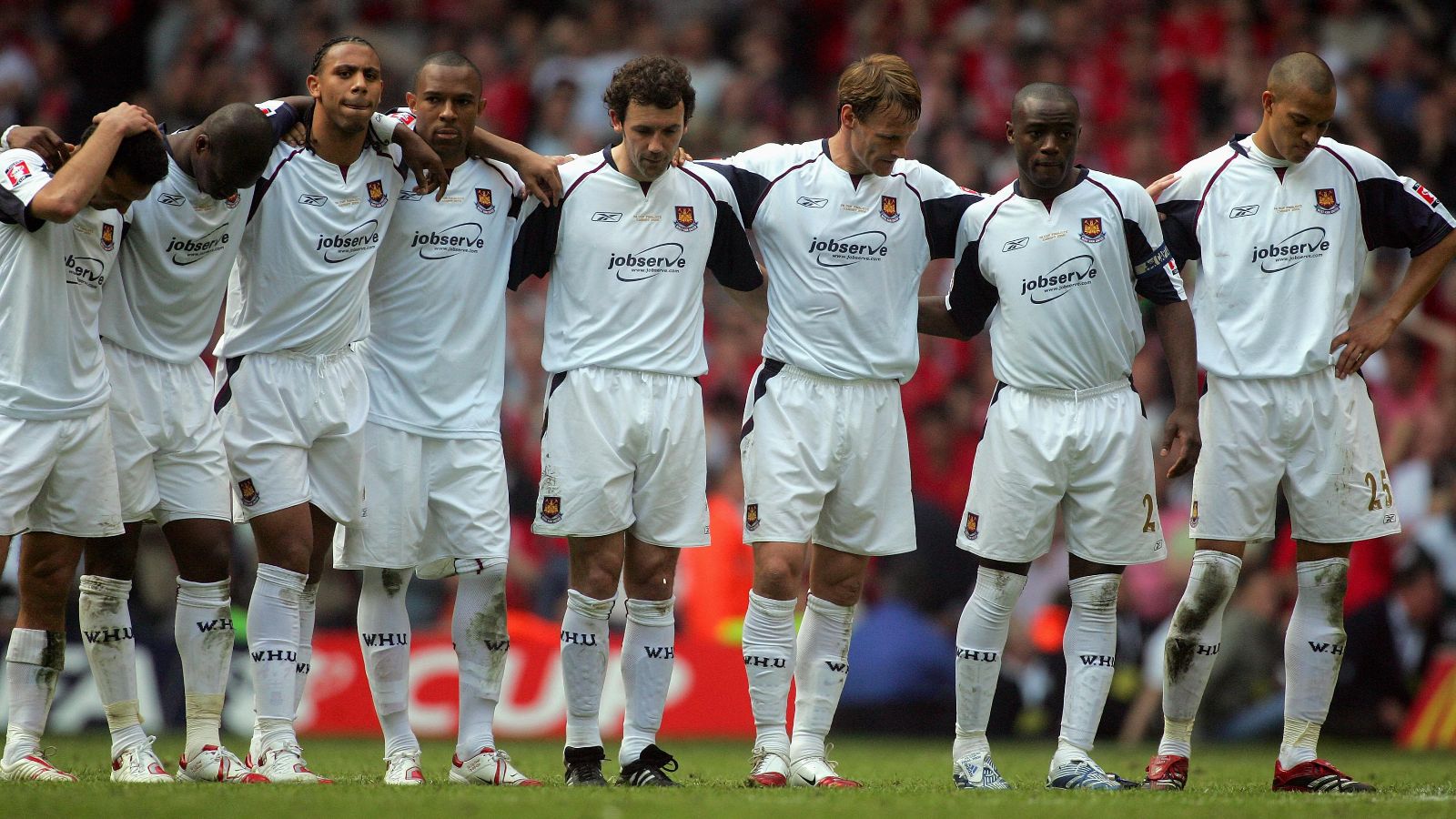
But nothing quite compares to 13 May 2006. That afternoon at the Millennium Stadium, Anton Ferdinand stepped up to take a penalty and my eleven-year-old self watched his shot sail wide. The tears came immediately, streaming down my face at home. Yet when Bubbles echoed around the ground afterwards, something remarkable happened—the Liverpool supporters stopped celebrating, turned towards the West Ham end, and applauded. In this era of social media mockery, it felt almost civilised. Victory does make magnanimity easier, and perhaps we're all closer than we think.
For two decades, I've half-wished we'd simply lost that match 2-0 in the most forgettable fashion imaginable. A goal either side, minimal fuss, forgotten by the time the final whistle went. Instead, our doomed heroism created what many consider the finest FA Cup final of the 21st century. Every year when the BBC trots out their "Magic of the Cup" montages, there it is—that goal. Enough to make you suddenly fascinated by your shoelaces or desperately need to change the channel.
The question became: why rewatch it on the twentieth anniversary? Nobody forced me. Dredging up a defining childhood memory for content feels like a rather hollow tribute. But time does strange things. I'd been in Prague for the Europa Conference League final, watching Jarrod Bowen score the winner against Fiorentina, and that trophy itch had finally been scratched. A day without complications, when people ring to congratulate you. Perhaps facing that old wound wouldn't feel quite so unbearable anymore.
So on an unseasonably warm April afternoon, nursing an unseasonably heavy cold, I loaded up YouTube and prepared to poke the wound.
The first observation: what a perfect setting it was. The sun streaming down, Cardiff's towering stands creating a proper amphitheatre. The FA should have abandoned Wembley's building works right then and there, annexed south Wales permanently. Probably would've cost less too.
This match had everything structurally required for a great cup final. A clear but not invincible favourite facing an underdog genuinely capable of causing damage, for whom the occasion meant everything. That's precisely why Manchester City versus Crystal Palace remains infinitely more compelling than Manchester City versus Chelsea. An all-underdog affair has novelty value but reeks of fear. This was the Goldilocks scenario—just right.
Rafa Benitez occupied the Liverpool dugout with the bearing of a Spanish Captain Mainwear, whilst Alan Pardew prowled the touchline in the sort of weathered sweatshirt you'd wear to the local tip. West Ham's men were brave, taking the fight to Champions League holders and racing into a 2-0 lead. Jamie Carragher's own goal and Dean Ashton's clinical finish had the Hammers supporters caught between disbelief and delirium—that West Ham feeling of waiting for karma to exact its price for glimpsing utopia.
Djibril Cisse quickly halved the deficit, but it was Nigel Reo-Coker who genuinely impressed. The twenty-one-year-old captain ran the midfield with authority, his performances earning him a spot on England's World Cup standby list. He'd become the face of the infamous "Baby Bentley" brigade at Upton Park, but on this day he was genuinely commanding.
After the interval, Pepe Reina denied both Yossi Benayoun and Marlon Harewood in quick succession. That felt like the turning point—the moment when Liverpool's superior pedigree would inevitably take hold. Gerrard began rampaging through midfield, the mood shifted, and the Liverpool captain crashed home an equaliser. My father, frustrated with John Motson and Mark Lawrenson's commentary bias, switched to the red button at that moment.
But then came Paul Konchesky's cross, floating over Reina for 3-2. The celebrations carried that same disbelief—because that's the fundamental difference between underdogs and favourites. West Ham believed they could win. Liverpool believed they would.
The distinction matters. As the match wore on, Liverpool seemed to run out of ideas after eighty minutes. Players were going down with cramp, Pardew made defensive substitutions, and the sense of inevitability seeped through everything. At eleven years old, I was still young enough to contain the bubbling excitement as the clock ticked down—this was about to be my first real taste of success, and nothing feels more important than football at that age, particularly when your school was full of glory-hunting Arsenal, Liverpool, and United supporters.
Then Lionel Scaloni—yes, that one—kicked the ball out for Cisse to receive treatment. Liverpool pressed him to give it straight back. The ball broke to Gerrard. I experienced genuine heartbreak for the first time.
Twenty years on, I forced myself not to look away. His shot contained everything—the last reserves of energy, struck low with the force of a thousand suns. Poor Shaka Hislop, by then well past his prime, had no chance.
Strangely, my stomach didn't drop. My eyes didn't flood with tears as they had in 2006. Instead, I felt oddly detached, as though the moment had become Ronnie Radford-levels of over-familiar despite deliberately avoiding it for two decades. Time had drawn the emotional sting without me fully realising it. It felt like "something that happened" rather than something existential.
I watched extra-time at 1.5x speed—marked by an impossible Reina save right at the end—before the penalty shootout where West Ham never looked like winning. In 2006, I couldn't stop crying for days. The immediate aftermath was brutal, but the worst came at school two days later when people were genuinely sympathetic. It took everything to hold it together.
We spend so much of our lives constructing protective webs, spinning coping mechanisms to keep real emotion at arm's length. But there's something rather wonderful about caring that deeply about something ultimately inconsequential. That's where the beauty lies.
The 2006 Cup final became a reference point—Ground Zero for understanding the complicated allure of imperfect experiences and the romantic notion of watching bubbles nearly reach the sky. It subtly shaped how I approached life's big moments, always bracing for the "Gerrard moment" when happiness gets snatched away.
Growing older meant consciously fighting against that pattern. Bracing yourself for disaster doesn't lessen the impact when things go wrong. In Prague, I made a deliberate choice to break the cycle and embrace the day fully. It changed nothing on the pitch, but it helped close the circle from 2006.
That's the thing about supporting West Ham. Nobody writes compelling books about contented authors, and nobody paints masterpieces without struggle. We want our football team's success hard-earned, the reward for years of thin gruel and thwarted dreams. No wonder West Ham chose me.
Compare options